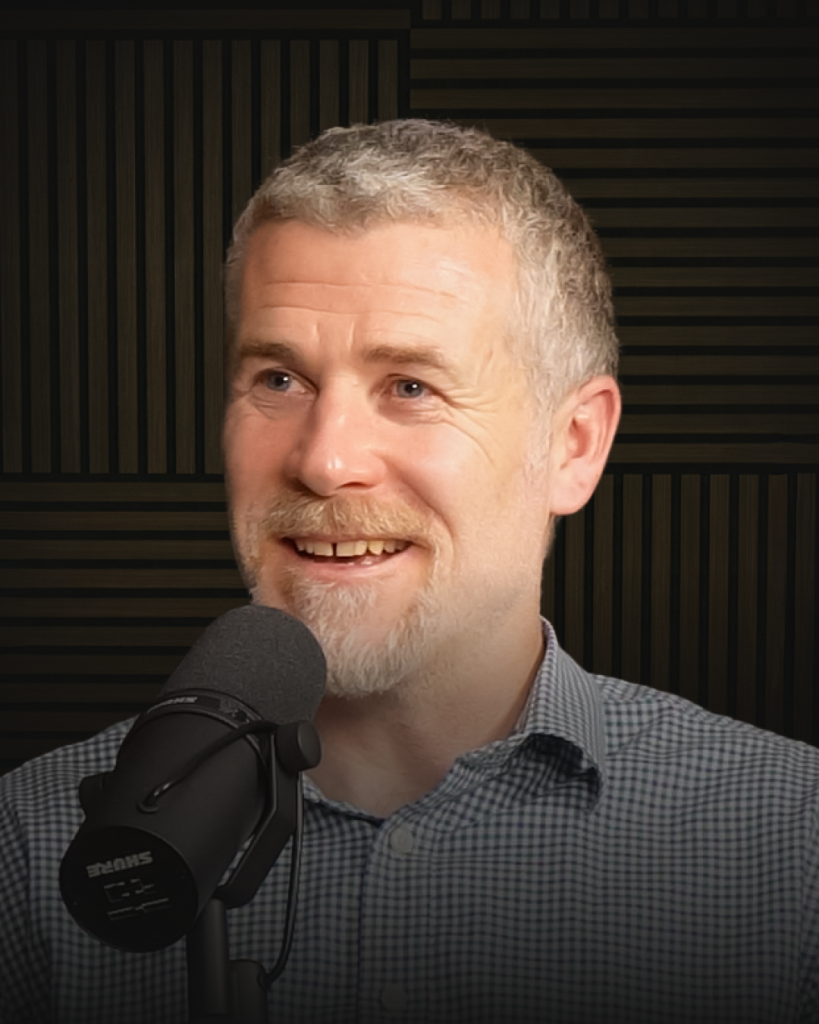
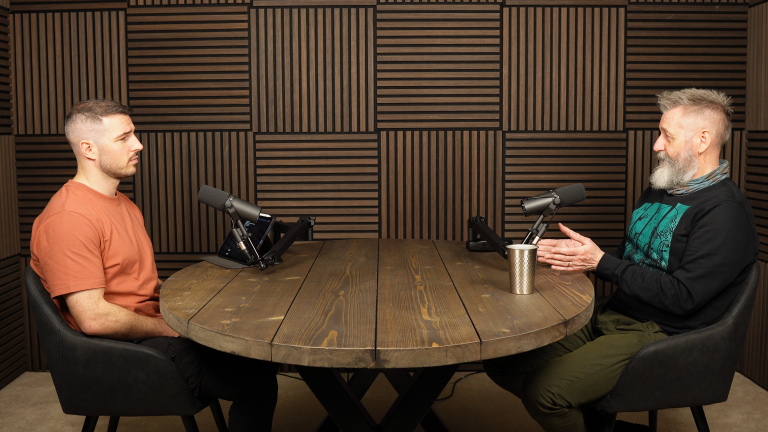
Emmett Johnston is on The Infinite Creators Podcast this week and I’m going to be thinking about what he said for a long time.
Emmett is a professional ecologist, a conservation voice, and the manager of Glenveagh National Park in Donegal, one of Ireland’s six national parks. He has more than 25 years of experience in nature conservation and environmental management. He has a master’s and a PhD. He co-founded the Irish Basking Shark Group. He volunteers with the RNLI. He’s a husband and father of three. He grew up in Dublin, escaped to the coast as a teenager, and ended up giving his life to the question of what it actually means for a country to live in relationship with its own land.
I brought Emmett on because I wanted to learn about Donegal’s wildlife, basking sharks, and the work of running a national park. What I got was a much harder and more honest conversation than I was expecting.
“Nature is messy. It is not in neat little squares.”
Emmett Johnston
That was the line that stayed with me when we stopped recording. Emmett wasn’t talking about gardens. He was talking about how a country, a culture, and a scientist all keep trying to draw clean fences around something that doesn’t want to be fenced. He spends his life on the wrong side of that argument, and he loves it.
The language tells you what the landscape lost
The first thing he said that stopped me was about Irish.
Glenveagh, where he works, is Gleann Bheatha. Glen of the birches. If you drop a busload of tourists into the middle of the valley and ask them where the birch trees are, they look around and see almost none. The name is still carrying the memory of a forest that has been gone for a long time. The English name doesn’t carry that. The Irish name does.
His point was bigger than one valley. The Irish language developed alongside the nature of this island for thousands of years, and a lot of what was here is encoded in the names of places, animals, and seasons. English was layered on top more recently, and the relationship most of us have with the land now reflects that. We see what is in front of us, not what used to be there. The language is a record we don’t read anymore.
A teenager, a national park, and a career nobody told him existed
Emmett grew up in Bayside in Dublin, sandwiched between two areas with very different lives going on inside them. His escape was Bull Island. He didn’t know it was a bird reserve. He just knew it was a place where the noise and trouble of the house and the streets stopped.
When he was fourteen or fifteen, his parents flew to Canada to look at houses and left him and his sisters at home with money that didn’t last. He found out about a volunteer programme in Killarney National Park, lied about his age to get in, and spent three weeks digging up rhododendron with a group of internationals. Halfway through, he asked the team leader how he ended up doing this for a job. The leader explained. Emmett decided that day he would do the same.
He went home, finished school, started a cabinetmaking apprenticeship, and quit because he couldn’t be indoors. His career guidance teacher told him there was no such job. He went to Wales, did a countryside management diploma, and worked his way back to Ireland over years that eventually led to a PhD on basking sharks. The version of his life where he listened to the careers teacher does not exist.
Meeting a dinosaur
He was working as a conservation ranger in Inishowen when he ended up on a boat heading out to Inishtrahull, the most northerly island of Ireland. On the way, they passed through a shoal of sixty or seventy basking sharks.
He said the closest comparison is meeting a dinosaur. They are seven or eight metres long, the size of the boat, and they don’t care about you. They cruise through the water at three or four knots with their mouths open, filtering plankton, completely indifferent to anything around them.
Emmett went home and tried to find out whether sixty or seventy basking sharks in one place was unusual. Nobody knew. There were no good population estimates. There was barely any rigorous data on a species this big and this visible off our own coast. That gap was the start of his research.
The Atlantic is their home, Ireland is one coast
A basking shark doesn’t need to come to the surface to breathe. It can spend its entire life in deep water, and a lot of them do, at depths of four hundred to six hundred metres in the open ocean.
What I had not understood is how far they move. Emmett and his colleagues tracked sharks from Malin Head into Scottish waters and back inside twelve hours. They tracked one to the Cape Verde Islands. They tracked another across to the east coast of North America. Talking about an “Irish shark” is mostly a political habit. The Atlantic is their home, and Ireland is one of its coasts.
The sharks come close to land for food. Strong tides around headlands push plankton into rich lines, and that’s what pulls them in. With drones, his team started seeing something else as well. The two or three sharks visible on the surface are often the top of a big slow circle of sharks moving together below the water. Not feeding. Possibly mating, possibly preparing to migrate. He called it a slow disco. We still don’t really know what it is.
He also showed, in his first scientific paper, that a basking shark can breach completely out of the water. The animal that looks like a slow cow is, when it wants to be, as explosive as a great white.
The countryside is not wild
The hardest part of the conversation was about land.
Most of us look at the hills and bogs of Donegal and assume we are looking at something natural. Emmett doesn’t. He sees a landscape that has been deforested, drained, overgrazed, and stripped of the species that used to keep it in balance. He pointed me towards Ordnance Survey teams who mapped Donegal in the early 1800s and wrote about town lands where you couldn’t find a single tree or bush for ten miles. That was before the famine, not after.
Glenveagh has had a deer herd that’s been overgrazing the valley for seventy or eighty years. There are no wolves left to keep deer numbers in check, so the park culls them. People sometimes get angry when they see trees being cut in a national park, but a lot of the trees they’re defending are non-native plantation pine from the last forty years, and the work is to clear space for native woodland to come back. The thing people are defending is often the degraded version, because that’s the version they grew up with.
Restoration, renewal, and not picking a year
He drew a distinction I keep thinking about. Conservation often means freezing a landscape at a particular moment, like a museum piece. The Lake District in England is run that way. Emmett doesn’t think Ireland should do that. He uses the word renewal instead. You put the building blocks back, you reduce the pressures, and you let nature decide where the trees actually go. You don’t pick 1800 or 1600 and try to recreate it exactly.
He said something I want to write on the wall. Nature is messy. It is not in neat little squares. Wet bits, dry bits, woodland, bog, rough ground, all overlapping and sliding into each other. The scientific instinct to draw a clean fence around each habitat is the opposite of how the land actually wants to work.
The wagging finger doesn’t work
Towards the end he talked about what he sees as the environmental movement’s biggest mistake. Making people feel guilty about living their lives. The image of the scientist on a soapbox telling everyone what they shouldn’t be doing. He thinks it pushes people away from nature instead of towards it.
He’s more hopeful than I expected him to be. There are more trees in Ireland now than there were a hundred years ago. We have more wealth, more time, and more attention to give to this than any generation before us. He thinks this generation gets to decide the next fifty or hundred years of Ireland’s relationship with its land, and he doesn’t think the answer is shame. It’s showing people something worth caring about and trusting them to care about it.
Humility
I asked him at the end what all of this had taught him. He said humility. That he is just passing through. That nature is the long story and he is a speck inside it. That the work is to leave the place a bit better than he found it without pretending he knows the whole picture.
That was the line I came away with. We are not here to dominate this island. We are not here to preserve it like a museum either. We are here briefly, and what we do in our time decides what the next people walk into.